Landscaping in DFW:
The complete guide.
North Texas isn't Florida and it isn't Colorado. Heavy clay soil, brutal summers, mild winters, and water restrictions all change what works. This is the field guide we wish every DFW homeowner had before their first project.
- Bermuda is the DFW default grass. Zoysia is the right pick for partial shade. St. Augustine works for shadier yards. Cool-season grasses (fescue, rye) do not survive DFW summers.
- The growing year is March–November. December–February is dormant. Sod install in late March / April is the best window of the entire year.
- Pre-emergent in early March and again in early September. Skip either window and weeds win the next season.
- Water deep and infrequent, not shallow and daily. Most DFW cities cap watering at 2 days per week — work with the limit, not against it.
- Hardscape, irrigation upgrades, and tree pruning are winter work. Cool weather, no plant stress, faster crews.
DFW climate snapshot.
Everything below is shaped by this. Pretending DFW is anywhere else is the most common reason landscapes fail here.
8a – 8b
Most of DFW. Frost dates roughly Mar 15 and Nov 22.
Clay (alkaline)
pH typically 7.5-8.2. Heavy, drains slow. Amendment critical for new beds.
~38"
Bimodal: wet spring, dry summer, second peak in fall.
100-108°F
90+ days at 95°F+ in a typical year. Watering is the limiter.
Twice/week max
Most DFW cities enforce two-day-per-week watering year-round.
Grass types that actually work.
Bermuda (the DFW standard)
Tifway 419, Tex-Turf, and other Bermuda hybrids handle DFW heat and high traffic better than anything else. Full sun required (8+ hours direct). Mow at 1.5-2 inches in spring/fall, 3-4 inches in peak summer. Goes dormant brown in winter — not dead, just sleeping.
Zoysia (the premium pick)
Palisades and Empire Zoysia handle partial shade better than Bermuda, feel softer underfoot, need mowing less often, and have a denser blade that crowds out weeds. Cost more than Bermuda. Slower to establish but worth it on the right yard.
St. Augustine (the shade option)
For yards with significant tree cover. Doesn't tolerate heavy traffic. Vulnerable to chinch bugs and gray leaf spot. The right pick for shaded back yards in Lakewood, University Park, and mature-tree neighborhoods.
Synthetic turf (the "no grass" answer)
If the yard is deep shade where nothing else grows, a pet run that gets destroyed, a small courtyard, a putting green, or anywhere recurring water+mow costs make real grass uneconomical — modern synthetic turf is the right call. Read more about synthetic turf →
Services we provide, briefly.
Six core services. Each one has its own deep page below. The complete cost ranges live on the pricing page.
Sod Installation
Bermuda, Zoysia, St. Augustine. One-day install.
Synthetic Turf
Pet runs, putting greens, deep shade, courtyards.
Lawncare & Maintenance
Weekly mow, edge, blow. Fertilization programs.
Native Landscaping
Drought-resistant Texas natives. Year-round color.
Paver Patios & Walkways
Paver patios, flagstone walkways, natural stone paths.
Holiday Lighting
Design, install, service, takedown, storage.
The DFW seasonal calendar.
Timing is the single biggest difference between a yard that thrives and a yard that struggles. Most failed lawns in DFW are timing failures: pre-emergent missed, sod installed in August, irrigation never adjusted for summer cycle.
Spring (March – May)
The single biggest window of the DFW landscape year. Bermuda and Zoysia wake up and put on roots. Pre-emergent goes down NOW or weeds win the summer. Mulch refresh and bed edging set up the curb appeal for the whole growing season.
- ·First pre-emergent application
- ·Sharpen mower blades
- ·Soil test if you haven't in 3 years
- ·Spring cleanup (mulch, edge, shape, color)
- ·New sod install (best window of the year)
- ·First fertilizer application
- ·Mowing cadence picks up to weekly
- ·Spot-treat weeds that beat the pre-emergent
- ·Adjust irrigation to summer cycle
Summer (June – August)
100+ degree days. Water is the whole game. Cut high (3-4 inches for Bermuda), water deeply but less often, and run irrigation at dawn. This is when synthetic turf, hardscape, and shade trees pay back the most.
- ·Raise mower deck to 3-4 inches
- ·Check sprinkler coverage during a manual run
- ·Second fertilizer (slow-release)
- ·Water deeply 2x/week, not daily shallow
- ·Mow weekly without bagging (return clippings)
- ·Watch for grubs and chinch bugs in stressed zones
- ·Plan fall aeration
- ·Schedule overseeding consultation for any thin Bermuda
- ·Late-summer color: lantana, salvia, plumbago thrive
Fall (September – November)
The recovery window. Aeration in October sets up a stronger root system for next year. Pre-emergent in late September or early October stops winter weeds (Poa annua, henbit). Fall cleanups and bed refreshes set up winter curb appeal.
- ·Second pre-emergent application
- ·Schedule fall aeration
- ·Begin tapering watering as temps drop
- ·Core aeration + overseeding (if Bermuda is thin)
- ·Fall cleanup (mulch refresh, bed edging)
- ·Last fertilizer of the year
- ·Holiday lighting reservation
- ·Leaf cleanup begins
- ·Winterize sprinkler system before first hard freeze
Winter (December – February)
Dormant season for Bermuda and Zoysia. Mowing pauses. This is the right window for hardscape installs (cooler labor, less plant disruption), tree pruning, irrigation upgrades, and any structural work that's disruptive in growing season.
- ·Holiday lighting active season
- ·Dormant tree pruning
- ·Hardscape installs (cooler weather is ideal)
- ·Holiday lighting takedown
- ·Plan spring scope (sod, landscape design, hardscape adds)
- ·Sharpen mower blades, service equipment
- ·Soil test results in hand
- ·First pre-emergent within 2-3 weeks of soil temp hitting 55°F
- ·Spring cleanup scheduling fills fast — book early
DIY or hire? Honest call.
Worth doing yourself
- Mowing a small front yard if you enjoy it
- Hand-pulling weeds you spot during a weekly walk
- Watering by hand for new shrubs in the first month
- Refreshing mulch in established beds
- Planting annual color in existing beds
Worth hiring
- Sod installation (one wrong step costs the entire investment)
- Synthetic turf install (base prep mistakes show up in year 2)
- Hardscape over 50 sq ft (drainage, base, settling)
- Sprinkler upgrades and zone resets (city code)
- Pre-emergent timing and product selection
- Tree pruning over 12 feet
- Holiday lighting on a two-story home
Read the full Loera vs independent vs DIY comparison →
DFW cities we serve.
Each city has its own page with HOA notes, neighborhood coverage, and locally-relevant watering rules. Find yours.
Carrollton
Our HQ. Trinity Mills, Old Downtown, Hebron, Castle Hills.
Plano
West Plano, Willow Bend, Legacy West, Bent Tree.
Frisco
Stonebriar, Newman Village, Phillips Creek Ranch.
Dallas
Lakewood, Preston Hollow, Lake Highlands, Oak Cliff.
Addison
Addison Circle, Vitruvian Park, Belt Line.
Lewisville
Castle Hills, Lakeway, Old Town, Lakepointe.
Coppell
Old Coppell, Riverchase, Lakes of Coppell.
Southlake
Carillon, Vaquero, Stone Lakes, Timberidge.
Highland Park
Old HP, Armstrong Parkway, Volk Estates.
University Park
SMU-adjacent, Hyer Park, Caruth Park.
Farmers Branch
Brookhaven, Historic District, Mercer Crossing.
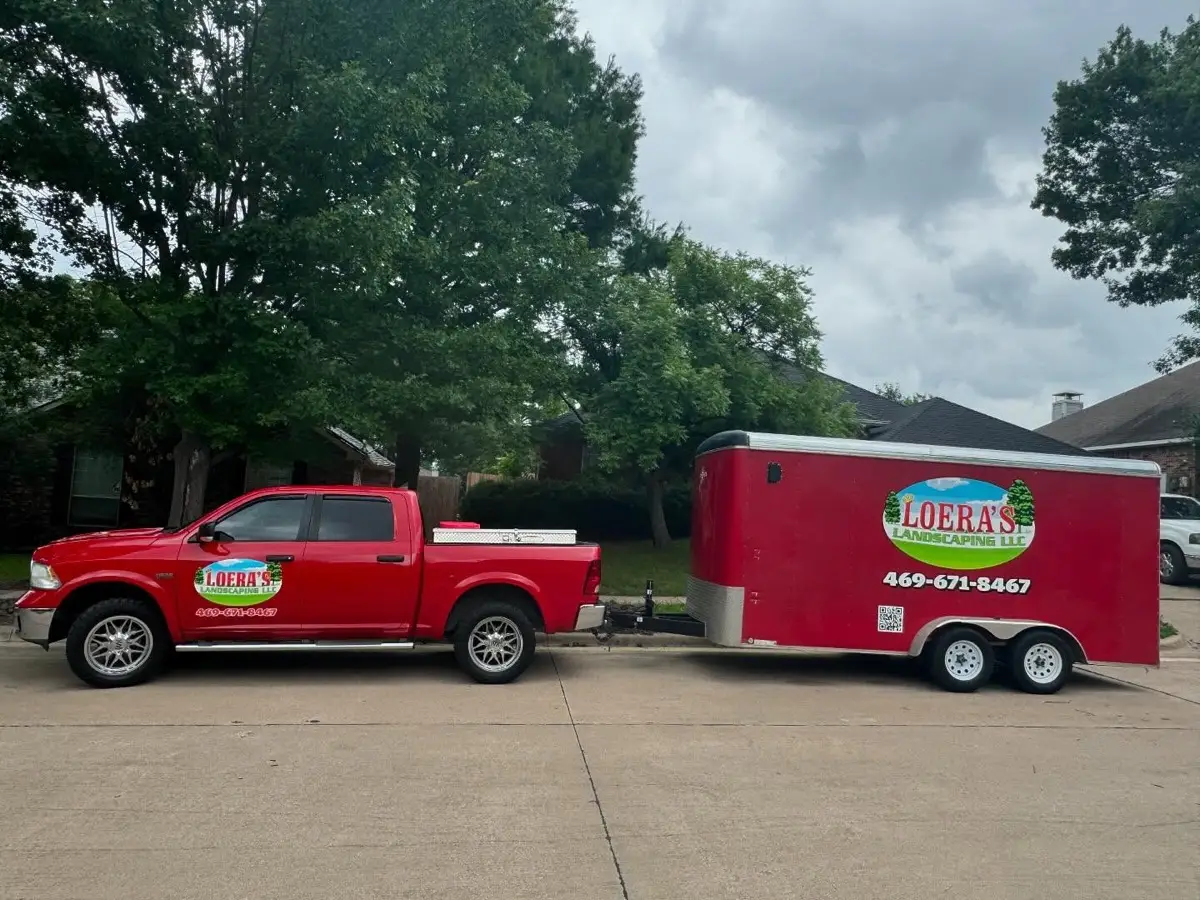
Omar Loera
Owner, Loera's Landscaping · 15+ years across the DFW metroplex
Born and raised in North Texas. Started Loera's Landscaping in 2010. Today the team handles sod, synthetic turf, lawncare, hardscape, native design, outdoor lighting, and holiday lighting across Carrollton, Plano, Frisco, Dallas, and the surrounding metroplex. Omar still does every on-site estimate personally. Written from 15 years of mistakes, fixes, and DFW-specific lessons we paid for so you don't have to.
Free on-site estimate.
20-45 minute visit. Fixed-price quote within 48 hours.